

Main Parts That Make Up a Rubber Vulcanizing Machine
A rubber vulcanizing machine is an essential piece of equipment in the rubber manufacturing industry, designed to improve the strength, elasticity, and durability of rubber products through heat and pressure. Understanding its main components helps operators maintain performance and ensure consistent production quality.
The frame forms the foundation of the machine, providing stability and support for all other parts. It is usually made of heavy-duty steel to withstand high pressure during the vulcanization process. The hydraulic system is another critical component, generating the necessary pressure to compress the rubber material evenly between molds. This system typically includes a hydraulic cylinder, pump, and valves that control movement and force.
At the core of the machine is the heating system, which may use steam, electric, or oil heating methods to achieve precise temperature control. Proper heat distribution is crucial to ensure uniform vulcanization. The mold or press platen holds the rubber product in shape during the process, directly influencing the final form and surface quality.
The control system plays an important role in coordinating temperature, pressure, and curing time. Modern vulcanizing machines often feature programmable logic controllers (PLC) and touch-screen interfaces for easy operation and improved accuracy. Additionally, cooling systems are often integrated to quickly reduce temperature after vulcanization, helping to maintain product consistency and reduce cycle time.
Each of these components works together to ensure efficient and reliable vulcanization. By understanding their functions and interactions, operators can optimize production, improve safety, and extend the lifespan of the equipment.
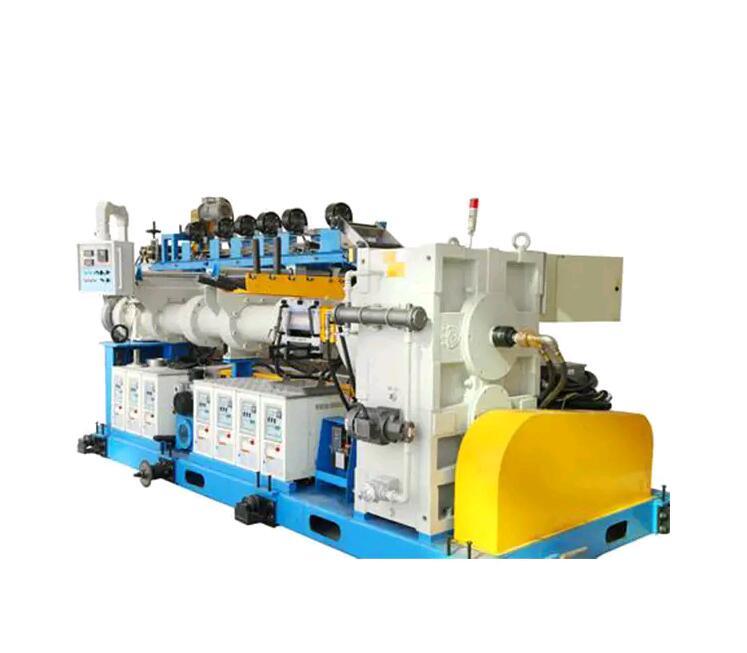
https://www.zjbaina.com/product/rubber-extruders-series/150mm16d-20d-extrude-machine.html
Technical description
Extruder:
Screw: (customized outsourcing)
A. Material: 38CrMoALA;
B. The surface is nitrided;
C. Hardness ≥ HRC62
D. Nitrogen layer depth ≥0.55mm
E. Structure: Adopts German Telest structure, with good extrusion stability and large glue output.
a. It has a hollow structure over the entire length of the screw to facilitate temperature control.
b. The rotation direction of the thread of the rotary joint is opposite to that of the screw.
c. The screw head size is according to the enterprise standard.
d. Water pressure of 10 kg/cm2 inside the screw is tested for more than 1 hour to prevent leakage.

 English
 Arabic
 Français
 Español
 Português
 Deutsch
 Türkçe
 Italiano
 Russian
 Romaian
 Português Brasileiro